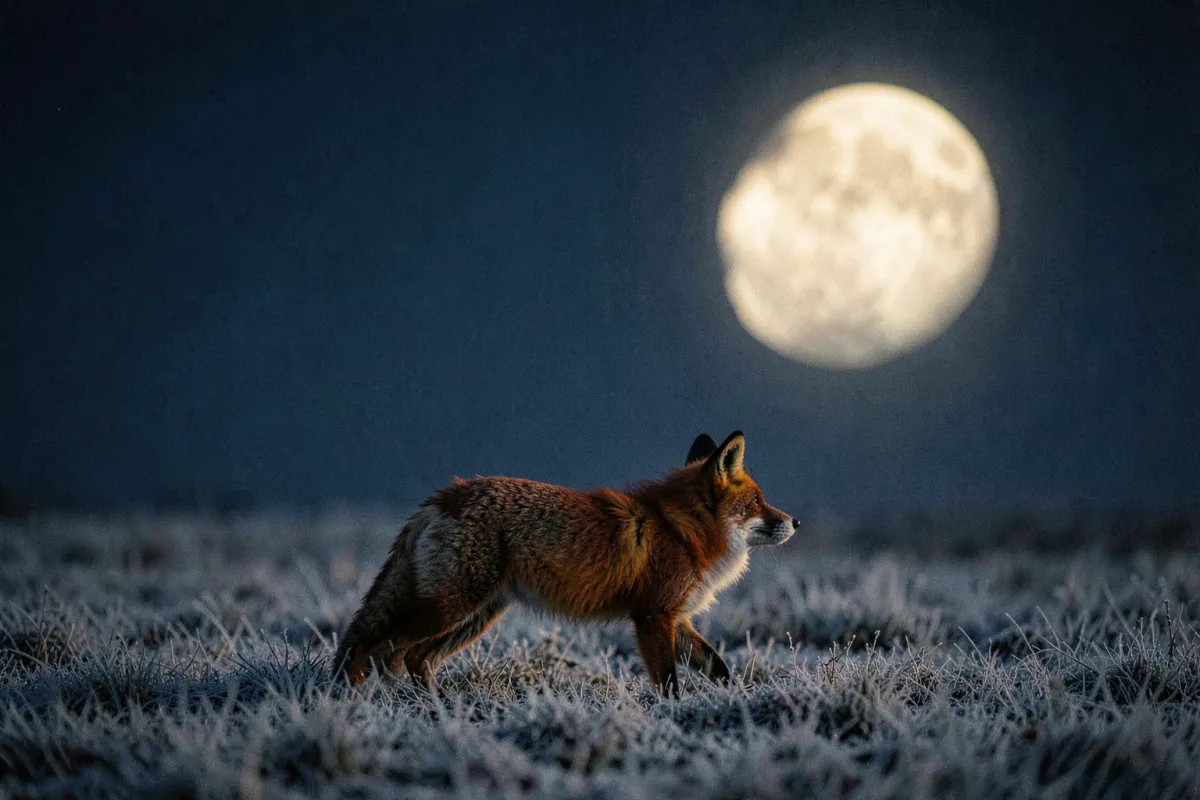
What the Fox Owed the Moon
Long ago, when animals could still make bargains, a fox loved three kits so much it hurt his teeth.
The winter of their birth was the black one — forty nights without moonlight, cloud sealed over the sky like a lid on a pot. The vixen had died. The den lay at the root of an oak in a country full of owls, and a blind fox is a dead fox’s father. So Reynard climbed the highest stone he could find and shouted up until his voice was red: Moon! Lend me your light. I’ll carry it down in my tail and give it back — name your price.
The clouds tore open just enough for one silver thread to drop, thin as a whisker, into the tip of his brush. And the Moon said, in the way moons do — not with words, but with a cold weight settling onto a creature’s heart so it would remember: One harvest night each year I will come walking, and you will give me what is owed.
Reynard carried the light home like a coal in his mouth. His kits nursed by its glow; he hunted by it; owls came and found the den defended by something that burned fox-orange and would not be bargained with. When spring came, he set the silver thread on the highest stone exactly as promised — but dawn stole over it while he slept, and the light ran upward into the sky, and where it had lain there remained only a shallow pool of melted-looking stone, which is why to this day you can find that moonlight collects in old standing stones if you watch them sideways.
That was long ago. Reynard is very old now; his muzzle has gone the color of frost, and his kits are grown with kits of their own, and he keeps his one promise: on the first clear harvest night each year he sits upon the mossy stone to wait for the Moon, who walks then, they say, along the rim of the birch wood.
This is that night. The moon tonight is enormous, close enough to read a face in — and there it comes down the birches, unhurried, the trees standing pale as a choir. Reynard sits up straight on his stone and braces himself, because he has spent forty years wondering what the Moon will ask of an old fox. His sight? One of his nine lives, if he had nine? The memory of his vixen — which is all he owns that isn’t already borrowed?
The Moon stops before him. Looks at him. And in the cold weight on his heart, Reynard finally hears the price he agreed to without knowing it:
You gave back the light, says the Moon. I came for what grew around it.
And Reynard understands — with the slow joy of a debt being canceled rather than collected — that what grew around the borrowed glow was everything the light made possible: the kits, the grandchildren, the forty harvest nights he has sat on this stone alive enough to be afraid. The Moon did not lend light to be repaid. It lent light to make witnesses. Every year it came walking not to take but to see — to look once more at what a small creature builds when it is trusted with a little brightness, and to remember it, because moons are very old and forget everything except what was paid for honestly.
“Then take it,” says Reynard, and means: remember it. He bows his brush. “It was always yours to keep.”
The Moon bends — you have seen this, everyone has, the way a full moon hangs low and huge over treetops on one particular night each autumn — and presses its whole cold face gently to his fox forehead.
He is found at dawn on the stone, gone the way lanterns go: not dead, just finished shining. His grandchildren sit around him until the light fully leaves his fur. And if you have ever seen a fox stop in a field at dusk, tilting its head up at nothing a person could see — it is only an old debt being honored, one harvest night a year, between two creatures who kept faith with each other longer than either expected to get the chance.