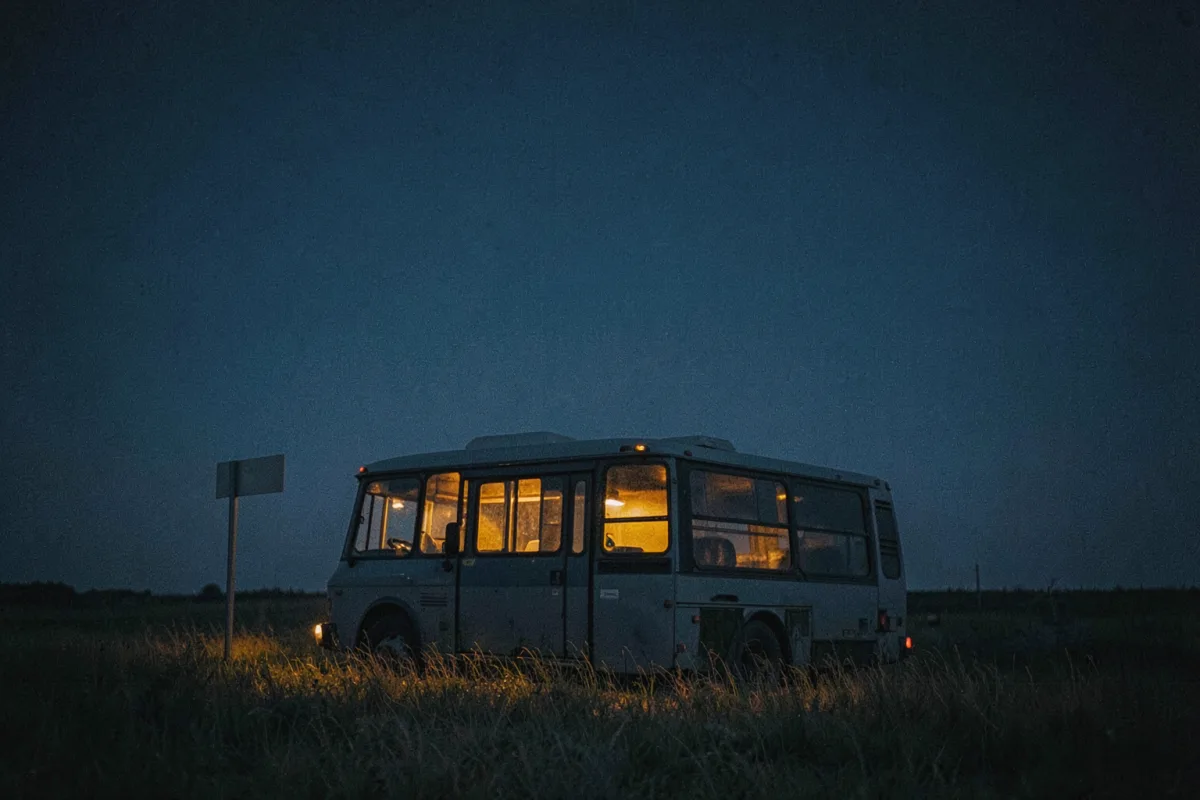
The Last Bus to Nowhere
Route 9 is the last bus in the city, and its last stop is called Nowhere, which the transit authority insists is a coincidence of translation: an old farmer’s field that once belonged to a man named Nowak, whose name got worn down by hurried mouths over generations into Nowhere. That is the official explanation. Osei worked the night route for six years and never believed it.
The truth he learned the way you learn most things on nights: gradually, then all at once. The bus was never empty at the terminus. There was always one passenger who boarded nowhere in particular and rode to the end — a nurse with her bag still clutched after a shift that went wrong; a teenager with paint under his fingernails and no paint-stained jacket anymore; an old man holding two gloves, only one of which had a partner. They never spoke. They watched the field go by in the dark, and at Nowhere they got off, walked into the grass toward nothing anyone else could see, and did not come back.
Osei’s rule for six years: drive, announce stops, don’t look too long at who steps off. Rules exist on night routes the way guardrails exist on bridges.
Then came the November night when a woman in a hospital-issued cardigan boarded at the last stop before the field with no bag and no coat, sat directly behind Osei — passengers always chose the back; she chose him — and said quietly: “My daughter rode your bus. Three weeks ago. I wasn’t able to get on with her.”
“Ma’am, this route loops. It comes back—”
“She didn’t mean to come back.” The woman’s voice was steady in the way voices are when steadiness is all that’s left holding anything up. “I just want to see where she got off. Please. I won’t make you break any rule you can name.”
Osei looked at his mirror for a long time. Rain needled the windshield. The field waited past the last streetlight, black and enormous, with the stars lying low over it like they were leaning in.
“There’s no stop there,” he said. “There never has been.” And then, because some debts are incurred simply by being the only one holding the wheel: “But I can take you to where the road ends, and leave the door open while you look. That isn’t a stop. That’s just a driver with bad eyesight who needs a minute.”
She thanked him without touching him, which he was grateful for; drivers on nights are not touched much.
At the end of the world — five minutes past Nowhere, where the route map gives up and prints only white — Osei parked under the stars and let the doors stand open. The woman walked out into the grass a few steps, looked around at nothing, and then did what they all eventually do, he realized: she stopped looking with her eyes and switched to whatever it is that keeps working after. And there, in the field’s dark, Osei saw them — because bad eyesight, he understood now, was just sight turned to a different channel — lights. Hundreds of them. Low, warm, moving slowly through the grass like lanterns at a festival no one had been invited to and everyone belonged at. Each one a bus-stop glow. Each one somebody’s last stop, still lit, still waiting for someone to come stand near it a while.
One light came toward the woman from far out in the field and stopped a few paces off, as close as it could get this side of things. She sat down in the wet grass in her cardigan and just stayed there, hands in her lap, faces lit by each other across the impossible distance.
Osei gave her eleven minutes. He counted them because someone should count something. Then he said, gently, “Ma’am — I can’t wait forever. It’s against every rule.”
“I know,” she said, getting up. She was soaked and smiling the ruined smile of the recently relieved. “Thank you. You didn’t break a rule. You bent one until it made room.”
She rode back to the city asleep in the seat behind him, and got off at her stop with her hands empty and her shoulders different somehow. Osei drove his loop. The bus was empty all the way to the field, which is to say — he finally admitted it to himself, pulling up under the stars for the last time before dawn — never once empty in six years.
Route 9 still runs nights. If you ride it to the terminus and the driver takes a minute with the doors open, don’t stare at the field too hard. But if your eyes go blurry on purpose out there, and something far off among the grass-lights lifts a hand —
Wave back. It’s only someone’s last stop, still lit. It’s only love, running its route one more time because the driver bent the rule and left the door open while it looked.